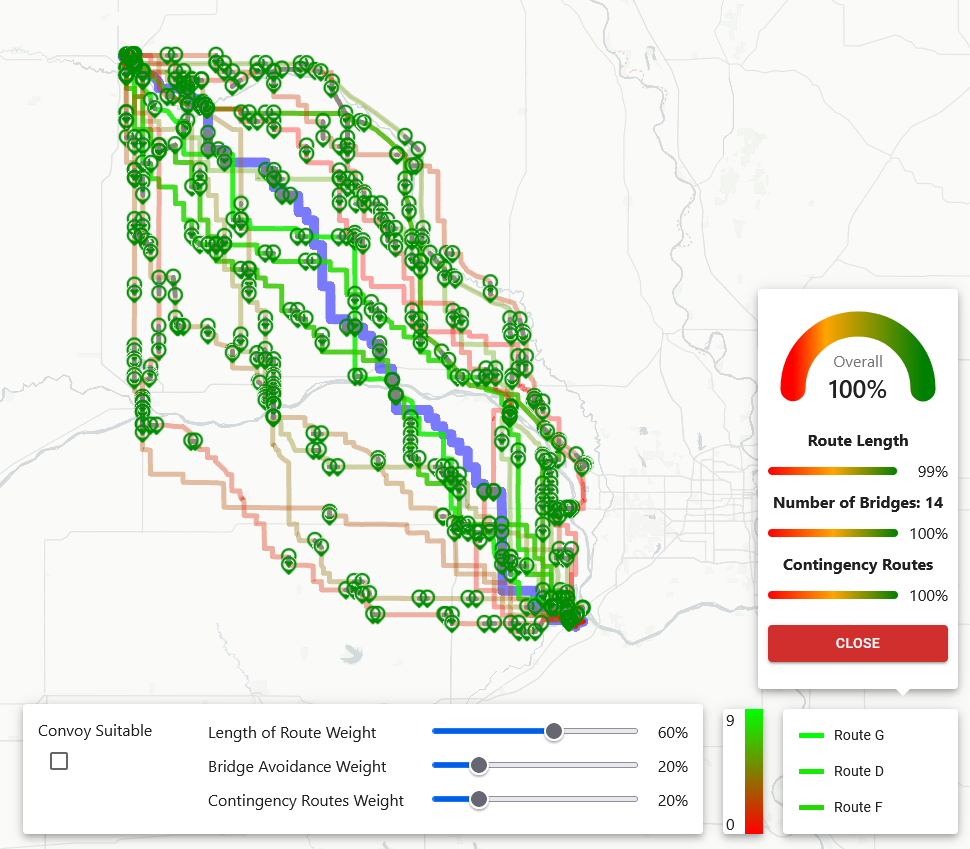
This project is a full-stack routing and visualization system built as part of my graduate research in collaboration with the U.S. Army Corps of Engineers. Its goal is to generate and evaluate multiple viable convoy routes between two points while accounting for infrastructure risk (specifically bridge health) rather than optimizing purely for distance.
The original UI for this project was developed under an institutional account and is no longer publicly accessible.
The system consists of three layers:
- A React front-end that lets users select start/end points, create “Convoys” with specific weights, and visualize candidate routes on an interactive map.
- A C# server that orchestrates execution, scores routes, and applies a multi-criteria heuristic.
- A Python routing engine (invoked by the server) that uses OSMnx and NetworkX to generate diverse candidate paths over a road graph built from merged OpenStreetMap (OSM) and National Bridge Inventory (NBI) data.
Rather than producing a single “shortest path,” the Python layer repeatedly computes shortest paths while dynamically penalizing previously used edges. This creates a set of structurally distinct routes. Each route is then returned to the C# layer, where it is scored using a weighted heuristic that accounts for:
- Total route length
- Bridge count and condition
- Overlap with other candidate routes (contingency value)
The UI exposes these weights in real time, allowing users to explore trade-offs between efficiency, safety, and redundancy. The result is an interactive planning tool that surfaces not just a route, but a portfolio of options suitable for convoy operations.
Technical Highlights
- Python route generation using OSMnx + NetworkX over real-world road graphs
- Iterative edge penalization to produce diverse, low-overlap paths
- C# middleware layer for orchestration, scoring, and data shaping
- React-based visualization with live weight tuning and multi-route rendering
- Integration of heterogeneous geospatial datasets (OSM + NBI)
Research Impact
This system was validated across 25 scenario-based simulations, each generating 15 candidate routes. It demonstrates how infrastructure health and redundancy can be incorporated into routing logic for operational planning.